

Plenty of homes sold in North Carolina still have a loan attached at closing. Selling before the loan is paid off happens every business day in Mecklenburg, Guilford and New Hanover counties. Nobody at the closing table blinks.
I hear the worry on the phone most weeks, usually phrased as some version of “am I even allowed to do this?” You are. Selling a house with mortgage debt still on it is routine here, and the real surprises are elsewhere. They’re the costs that only show up when the settlement statement prints, and what to do when the numbers don’t cooperate.
Can You Sell a House with a Mortgage in North Carolina?
Yes, and the loan gets paid off from your sale proceeds. Once the buyer’s money comes in, the closing attorney wires your lender the balance owed, and whatever’s left is yours.
A deed of trust secures most home loans in this state, not a mortgage in the technical sense. Everybody uses the word mortgage anyway. That document gives your lender a claim against the property until the loan clears. Selling a house with mortgage debt attached doesn’t violate that claim, because paying it off at closing satisfies it.
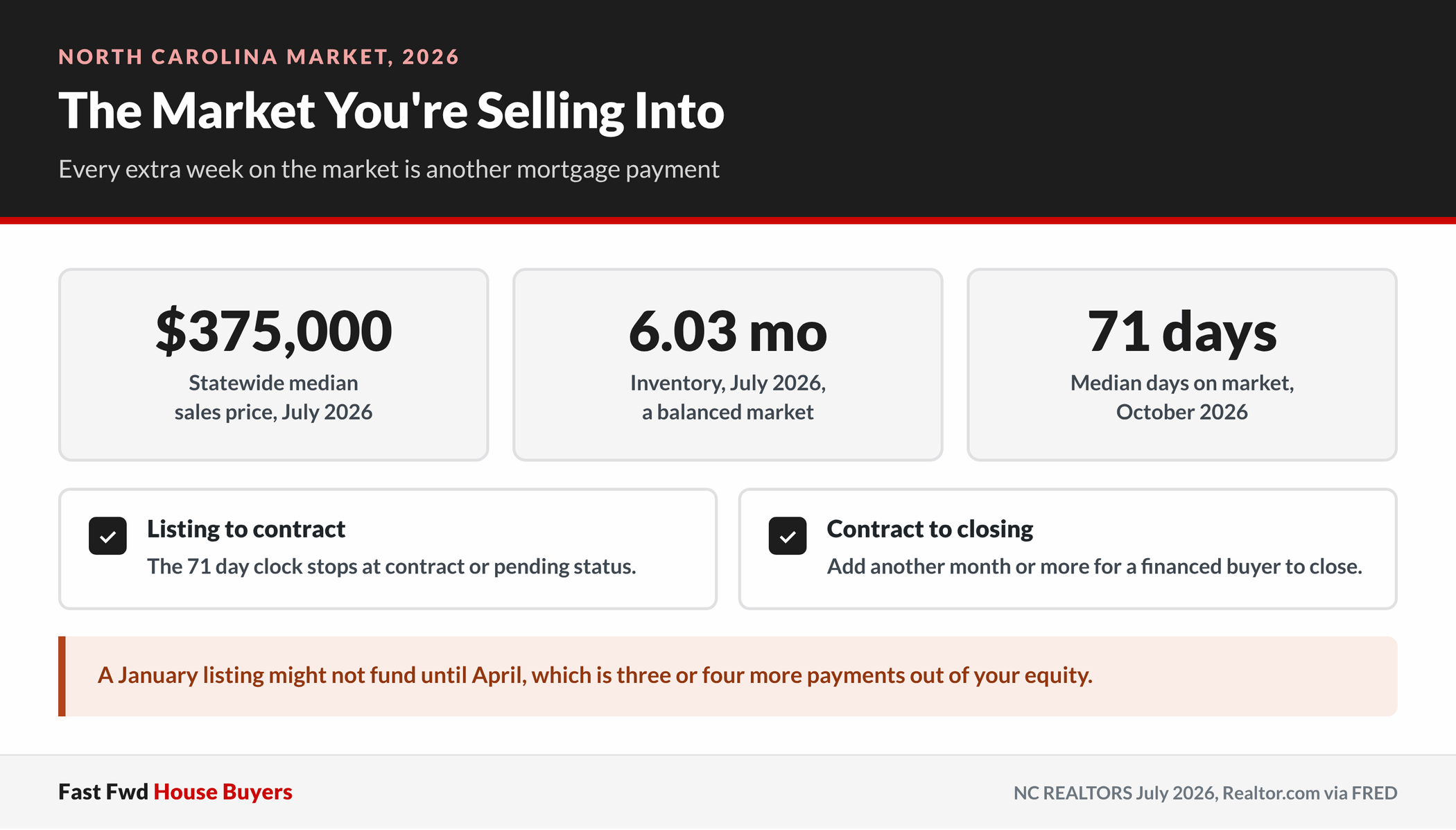
The market you’re selling into matters too. NC REALTORS® publishes a statewide housing snapshot each month. Its July 2026 report showed the median sales price holding at $375,000, with inventory at 6.03 months, which it calls a balanced market.
Early last year I got a call from three siblings in Kannapolis who had inherited their mother’s brick ranch. They had fallen three months behind on the payments, with an auction date already on the calendar. We closed before that date. Their lender got paid in full from the proceeds, and the siblings split what was left.
Sellers often underestimate how much timing matters. Selling a house with mortgage debt and a looming deadline means the clock on the calendar and the clock on your loan don’t run at the same speed.
What North Carolina Mortgage Laws Should Sellers Know?
Picture a seller who signs everything on a Tuesday morning, drives home, and expects a check in the mailbox Wednesday.
North Carolina runs closings through attorneys. State law requires a licensed attorney to conduct or supervise all real estate closings here. Most of the country uses title companies instead. For anyone selling a house with mortgage financing in place, that’s good news. The settlement agent, usually that closing attorney, requests the written payoff figure directly from your loan servicer.
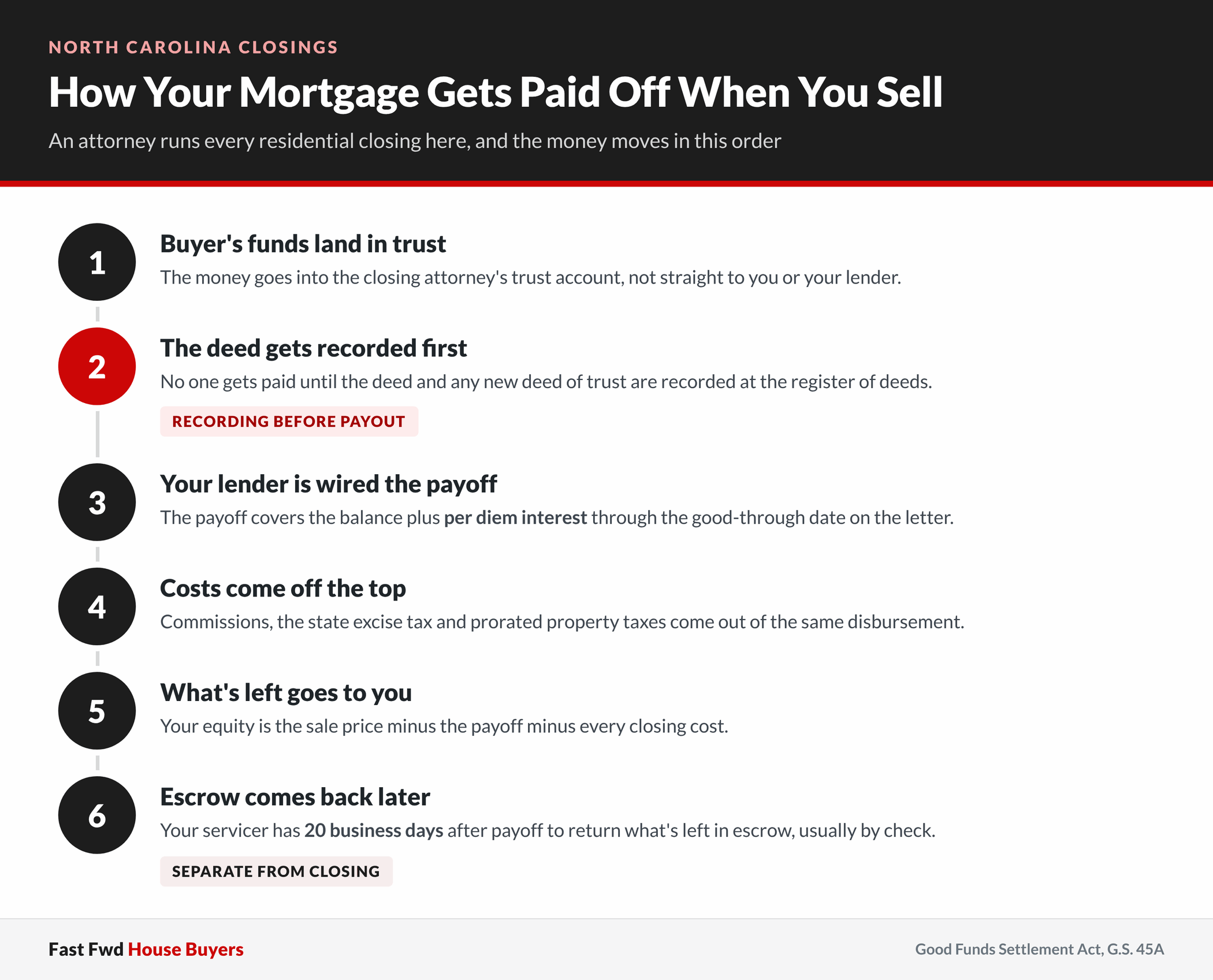
One funding rule is worth knowing. Under the Good Funds Settlement Act, money can’t be disbursed until the deed and any new deed of trust have been recorded. Both proceeds and your lender’s payoff wait on that recording. Plan accordingly if you’re counting on sale money for a deposit somewhere else.
Then there’s the state’s transfer tax, and the seller pays it. By statute, the rate is one dollar for each five hundred dollars of the sale price or any fraction of that amount. Payment goes to the register of deeds before the deed can be recorded. You can read the rate and the rule directly at the NC Department of Revenue’s excise tax page. Seven coastal and northeastern counties, including Dare, Currituck, Camden, Chowan, Pasquotank, Perquimans and Washington, add a local land transfer tax on top. Confirm with that county’s register of deeds if your property sits there.
After the payoff clears, the old deed of trust has to be cancelled in the county records. An attorney can monitor that cancellation and follow up if it isn’t recorded in a timely way. I’d push on this one. An uncancelled lien sitting in the record is a headache you don’t want surfacing later.
Do You Need Lender Approval to Sell a House with a Mortgage in North Carolina?
A landlord in Gastonia once held off on listing a rental for four months because he thought his servicer had to sign off first.
Nobody at the bank approves the sale. Your lender just gets paid. When you sell a house with mortgage debt that your sale price fully covers, the servicer simply issues a payoff letter and cashes the wire.
There’s one scenario where sellers genuinely need approval: when the sale price won’t cover the debt. That’s a short sale, and your lender has to agree to accept less than it’s owed. More on that shortly.
Prepayment penalties are the other thing North Carolina sellers ask about. Most standard home loans written in the last decade don’t carry them, but your note is the only authority on your particular loan. Pull it out and look.
What you do want from your servicer is a payoff statement, not permission. The borrower, the record owner, or an authorized closing attorney can request that payoff. It’s good through a specific date, so missing it means you need a fresh one with updated per diem interest.
Have you checked what your loan balance actually is this month, not what it was when you refinanced? Oddly enough, the principal figure on your last statement and the payoff figure are rarely identical. Payoff includes accrued interest through the closing date plus any recording or statement fees the servicer charges.
Companies like Fast Fwd House Buyers handle the payoff coordination as part of buying the house. It takes one moving part off your plate when you’re already up against a deadline.
How Does a Mortgage Payoff Work When You Sell in North Carolina?
Sellers overthink the loan balance and underthink the costs stacked on top of it, and that’s backwards.
When you sell a house with mortgage obligations still open, the order of operations at closing looks like this. Buyer’s funds land in the attorney’s trust account. After that, the attorney records the deed at the register of deeds and disburses according to the signed closing statement. Out of that disbursement goes the wire to your lender. Commissions, excise tax, and prorated property taxes come out too. What remains lands in your account.
Agent commissions are the biggest line by far. Sellers here often cover both the listing agent’s and the buyer’s agent’s commission, and together those can run around five to six percent of the price. On a sale near the statewide median, you’re looking at roughly twenty thousand dollars of your equity gone before the loan payoff even gets subtracted.
Per diem interest is the sneaky one. The payoff letter quotes a good-through date and a daily interest amount. Close three days late and the amount owed is higher than the letter says.
One pattern I keep running into: sellers who assume their escrow balance gets credited at closing. It usually doesn’t. Federal servicing rules give the servicer 20 business days after payoff to return what’s left in escrow, usually by check in the mail.
What Happens to Your Mortgage Balance at Closing?
Think of the settlement statement as a stack of subtractions.
Your equity is the sale price minus the payoff minus every closing cost. Selling a house with mortgage debt that’s close to your home’s value leaves a thin margin, and closing costs eat thin margins fast.
Days on market feed directly into this. North Carolina’s median days on market hit 71 in October 2026, up from 69 in September and 66 in August, according to Realtor.com data compiled by the Federal Reserve Bank of St. Louis. That clock stops at contract or pending status, so add another month or more for a financed buyer to close.
So a listing that goes up in January might not fund until April. That’s three or four more monthly payments draining your equity while you wait.
Local numbers vary a lot. On that same Realtor.com series, Mecklenburg County listings sat a median 51 days in June 2026, below the statewide median for that month. Over in Wake County, the register of deeds reported a median sale price of $440,000 for July 2026, down $18,500 from June.
What If You Owe More on Your Mortgage Than the Home Is Worth?
Say your payoff is $310,000 and comparable sales in your Winston-Salem neighborhood are landing near $285,000. You’re underwater by twenty-five thousand before a single closing cost.
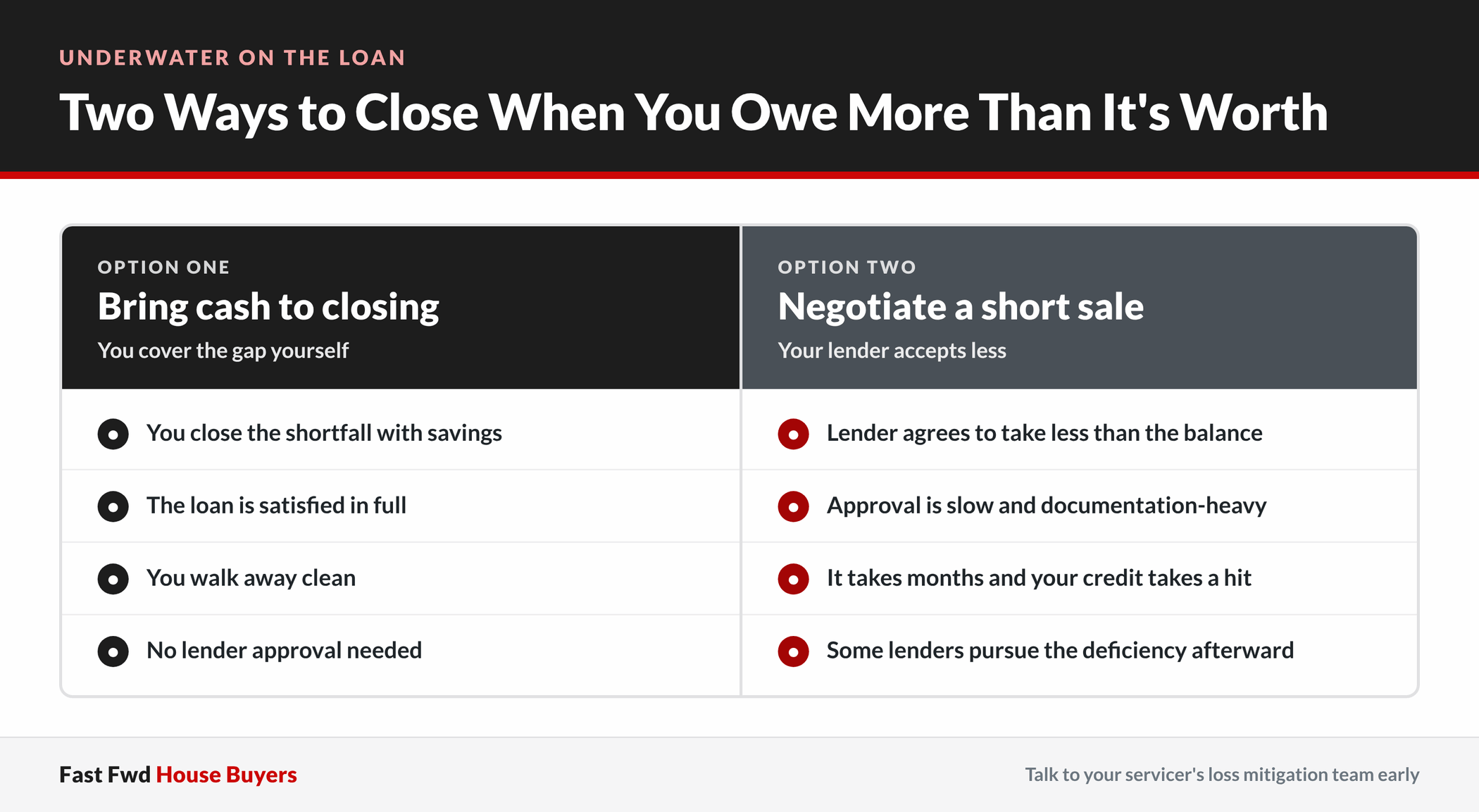
Bring cash to the table. If you’ve got savings, you close the gap yourself and walk away clean with the loan satisfied.
Negotiate a short sale. Your lender agrees to take less than the full balance and release the lien so the sale can close. Approval is slow and documentation-heavy, and it depends on your servicer’s loss mitigation department. A closing attorney and an agent with short sale experience should drive this.
What I won’t tell you is that a short sale is painless. It takes months, your credit takes a hit, and some lenders pursue the deficiency afterward depending on the loan type and what the approval letter says.
A hard truth about being underwater on a house with mortgage debt is that waiting can help. The longer you keep making payments, the better your position gets, as long as you can afford them. Each payment chips at principal. If you can’t afford them, waiting makes everything worse.
What Options Do You Have When Selling a Mortgaged House in North Carolina?
Pick the path that fits your timeline, not whatever a neighbor did last spring.
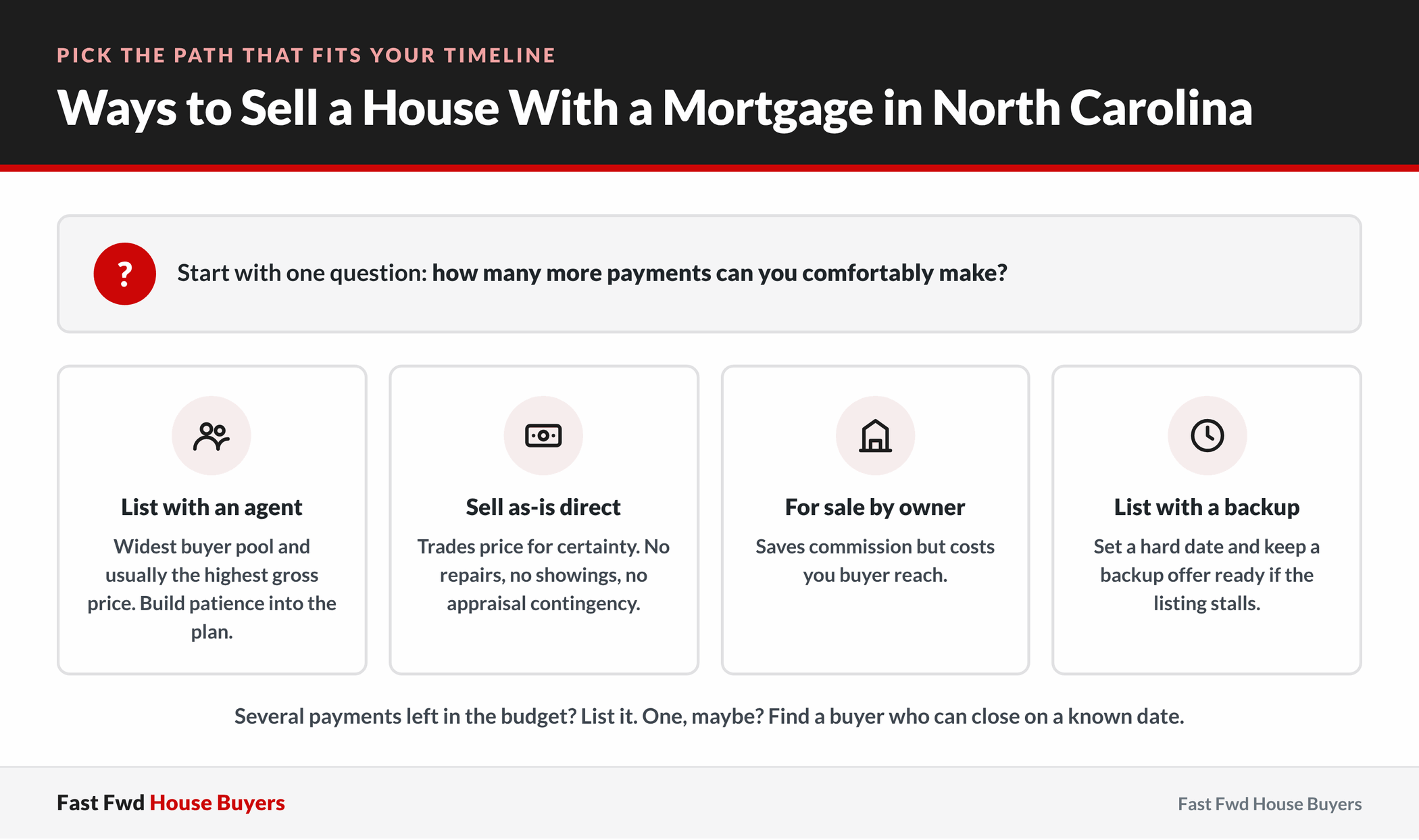
Listing a house with mortgage debt through an agent gets you the widest buyer pool and usually the highest gross price. NC REALTORS® told agents in July 2026 to prepare sellers for longer days on market, so build patience into the plan.
Selling as-is to a direct buyer trades price for certainty. No repairs, no showings, no appraisal contingency blowing up at day forty. For sellers with a house with mortgage payments they’re struggling to make, certainty is often worth more than the last eight percent of value.
Going the for sale by owner route saves commission but costs you buyer reach. I’ve watched FSBO sellers in Fayetteville and Jacksonville sit for five months, then list with an agent anyway.
A hybrid worth considering: list it, set a hard date, and keep a backup offer ready if the listing stalls.
Which of these fits depends on one question: how many more payments can you comfortably make? If the answer is “several,” list it. Answer “one, maybe,” and you need a buyer who can close on a known date. Fast Fwd House Buyers works in that second lane, buying directly and coordinating the payoff with your servicer so there’s no financing contingency to fall through.
Can You Use Seller Financing with an Existing Mortgage?
Won’t the bank just call the loan due the moment you try this? For years I assumed a due-on-sale clause meant seller financing over an existing loan was flatly illegal. Wrong. It’s contractual, not criminal.
Nearly every deed of trust written in the past forty years contains a due-on-sale provision. Transferring the property without paying off the loan gives the lender the right to call the entire balance due immediately. Whether a given servicer uses that right is a separate question, and betting your family’s housing on that guess is a bad bet.
Legally, you can offer seller financing on a house with mortgage debt still attached. Wisely, you almost never should without a payoff, unless the underlying loan is assumable.
Assumable loans are the real opportunity for a house with mortgage terms worth keeping. Many FHA and VA loans allow a qualified buyer to take over the existing note, including its interest rate. With older low-rate loans still on the books across North Carolina, an assumable note at a below-market rate is a genuine selling point. A servicer still has to approve the buyer, and the paperwork can take a couple of months. It’s clean, though, and the loan itself permits it.
Wrap-around loans and subject-to arrangements are a different animal. The original borrower stays personally liable on the note while someone else makes the payments. If that someone stops paying, the foreclosure lands on your credit, not theirs. Any seller considering that structure should sit down with a North Carolina real estate attorney first, not a weekend seminar.
A man called on a weekday afternoon from Mint Hill, splitting assets in a divorce and wanting none of it anymore. He’d been looking at creative financing ideas to stretch the payout, but once we walked through the liability he dropped the idea. We bought the house with its detached workshop still half-stocked with lumber, paid the loan off at closing, and the proceeds split cleanly between the two of them.
Frequently Asked Questions About Selling a House with a Mortgage in North Carolina
Can You Sell Your House Before the Mortgage Is Paid Off?
Yes, and selling a house with mortgage debt still on it is perfectly normal. The loan gets satisfied out of your sale proceeds at the closing table, and you keep whatever’s left after the payoff and the closing costs described earlier. No special permission from your lender is needed as long as the price covers what you owe.
How Soon After Buying Can I Sell a House with Mortgage Debt in North Carolina?
There’s no waiting period written into state law. Your note might carry a prepayment penalty if it’s an older or non-conventional loan, so read the document or ask your servicer directly. The bigger issue is usually equity: selling within the first year or two often means closing costs exceed the principal you’ve paid down.
Who Handles the Payoff When I Sell a House with Mortgage Financing Here?
Your closing attorney does. North Carolina’s attorney-supervised closing model means that lawyer requests the payoff figure from your servicer, holds the buyer’s funds in trust, records the deed, and then wires your lender. You can request the payoff statement yourself too, and I’d suggest you do, just to see the number before closing day.
What Happens If My House Sells for Less Than I Owe?
Your lender has to agree to release its lien for less than the full balance, which is the short sale route covered above. The alternative is covering the shortfall in cash at closing. Start the conversation with your servicer’s loss mitigation department early, because approvals take weeks and sometimes months.
Does the Buyer’s Financing Affect My Mortgage Payoff?
Not the payoff amount itself, but very much the timing. A buyer using conventional financing adds appraisal and underwriting steps that extend the calendar, and every additional week is another week of interest accruing on your loan. Cash removes those steps altogether.
Is Selling a House with Mortgage Arrears Possible If Foreclosure Has Started?
Usually yes, right up until the sale is finalized. The payoff will include the missed payments, accrued interest, and the lender’s attorney fees, so the number is higher than your regular balance. Move quickly and get your closing attorney talking to the servicer, because the window narrows as the sale date approaches.
Will I Owe Taxes on the Money I Walk Away With?
The excise tax described earlier comes off at closing automatically. Capital gains are a separate matter handled on your income tax return, and the federal exclusion for a primary residence covers a lot of sellers. Talk to a CPA before you spend the proceeds, especially if the property was a rental.
Selling a House With a Mortgage in the Charlotte Area
Charlotte is our home market, and its numbers track close to the state’s. The Canopy Realtor Association put the Charlotte region’s median sales price at $427,500 for August 2026, up 0.6 percent from a year earlier, as WFAE reported. If you’re carrying a loan on a house in Charlotte, Gastonia or Concord, the payoff math works the same way.
Want Help Running Your Payoff Numbers?
If you’re sitting with a house with mortgage payments you’d rather not keep making, or you just want someone to run the payoff math with you honestly, we’re glad to talk it through. We’ve bought houses across North Carolina in just about every situation you can name, and plenty of those calls end with us telling someone they’d do better listing it. No pressure either way. When you’re ready, reach out to Fast Fwd House Buyers or fill out the short form below.