
A seller in Greensboro once told me she’d rather spend six Saturdays showing her own home than hand a stranger five figures at closing. She wasn’t wrong to feel that way. Selling a house by owner in North Carolina is legal, common, and for certain sellers it’s the smartest move on the board. For others it turns into a four-month lesson in why commissions exist. Which group you land in usually comes down to the house, the market and your calendar.
What Are the Benefits of Selling a House by Owner in North Carolina?
A retired couple in Winston-Salem had already found their buyer: the neighbor’s son, who’d been renting across the street for three years. Paying a broker to introduce two people who’d shared a driveway since 2019 made no sense to them.
The cleanest case for selling a house by owner in North Carolina is this. You’ve got a buyer, or you’ve got a property so desirable it sells itself, and the commission is pure leakage. Listing and buyer agent commissions are negotiable, but together they still take a meaningful slice of most sales here. On a mid-priced home that’s real money going out the door.
You set the showing schedule. Answering the buyer’s questions yourself matters more than people give it credit for, since you know why the crawlspace vent was replaced and your agent doesn’t.
Going the for sale by owner route also keeps sellers’ timeline flexible. Need to close after the school year ends in June? You negotiate that directly instead of relaying it through two brokers.
One seller I bought from in Statesville had inherited her father’s house with a garage full of his fishing gear. We closed as-is, and she never had to pick a countertop.
The quiet advantage of the FSBO process is this: you can sell it yourself in whatever condition it’s in. There’s no listing agent pushing you toward a pre-market renovation that won’t pay for itself. If you’d rather skip the showings, local buyers like Fast Fwd House Buyers make direct offers on properties as they sit.
What Challenges Will You Face Selling a House by Owner in North Carolina?
Plenty of sellers picture the savings as a clean deposit into their account. The arithmetic gets messier fast, because the buyer’s agent still wants paying in most sales. Homes I’ve seen sit longest are almost always the ones priced by hope.
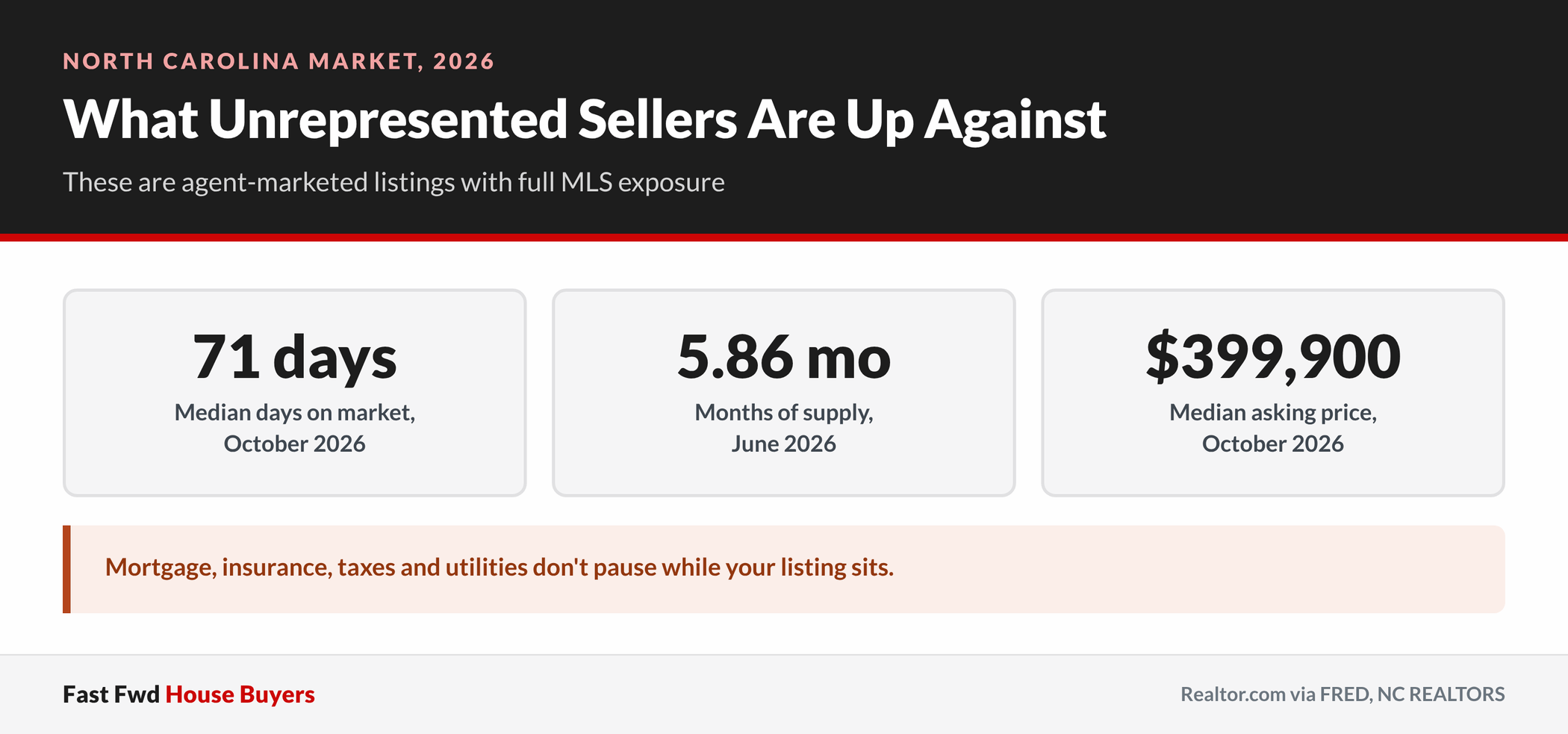
Market conditions aren’t doing unrepresented sellers any favors right now. Statewide median days on market hit 71 in October 2026, per Realtor.com data published through FRED, up from 58 in June. That’s a slow drift in the wrong direction.
Market inventory backs that up, since NC REALTORS® reported 5.86 months of supply for June 2026, and those are agent-marketed listings with full MLS exposure.
Mortgage, insurance, taxes, and utilities don’t pause for your education.
Market exposure is the harder problem. Buyers here search Zillow and Redfin, and both pull heavily from MLS feeds that FSBO sellers reach only through flat-fee listing services.
A buyer’s agent negotiates for a living and will read your motivation off your face during the walkthrough. I’ve watched unrepresented sellers concede repairs during the inspection period that an experienced negotiator would have split or refused outright. Emotional attachment gets the better of people in that moment. Your own kitchen is the hardest room in the world to hear criticized.
Inspection findings catch people sideways too. A buyer brings in a licensed inspector, the report lists eleven items, and suddenly you’re renegotiating a contract you thought was done.
Is Selling a House by Owner in North Carolina Right for You?
One landlord in Fayetteville listed his duplex himself, fielded nine calls in a week, and had it under contract by the following Friday.
Same strategy, opposite results. The variable is almost never the seller’s intelligence; it’s the property and the circumstances around it.
Selling by owner works well if your home is in a desirable school zone, needs little work, and sits in a market where buyers are already circling. It works if you’re comfortable with strangers in your house and can keep your composure when someone calls your sunroom addition “dated.”
Deferred maintenance scares off financed buyers, and financed buyers are most of the pool. If your house is packed with years of belongings, our guide on how to sell a hoarder house in North Carolina walks through your options.
Consider your calendar honestly. Are you available on weekday afternoons when a buyer’s agent wants a 2 p.m. showing? That one question disqualifies more sellers than any other.
Timing matters too, since the state’s spring market from March through June pulls the deepest buyer pool in most metros, from Charlotte’s Plaza Midwood to the Wilmington beaches.
Investors buy as-is, close on your date, and skip the appraisal contingency altogether. You trade some price for certainty, and for a lot of folks that trade is worth making.
How Do You Sell a House by Owner in North Carolina Step by Step?
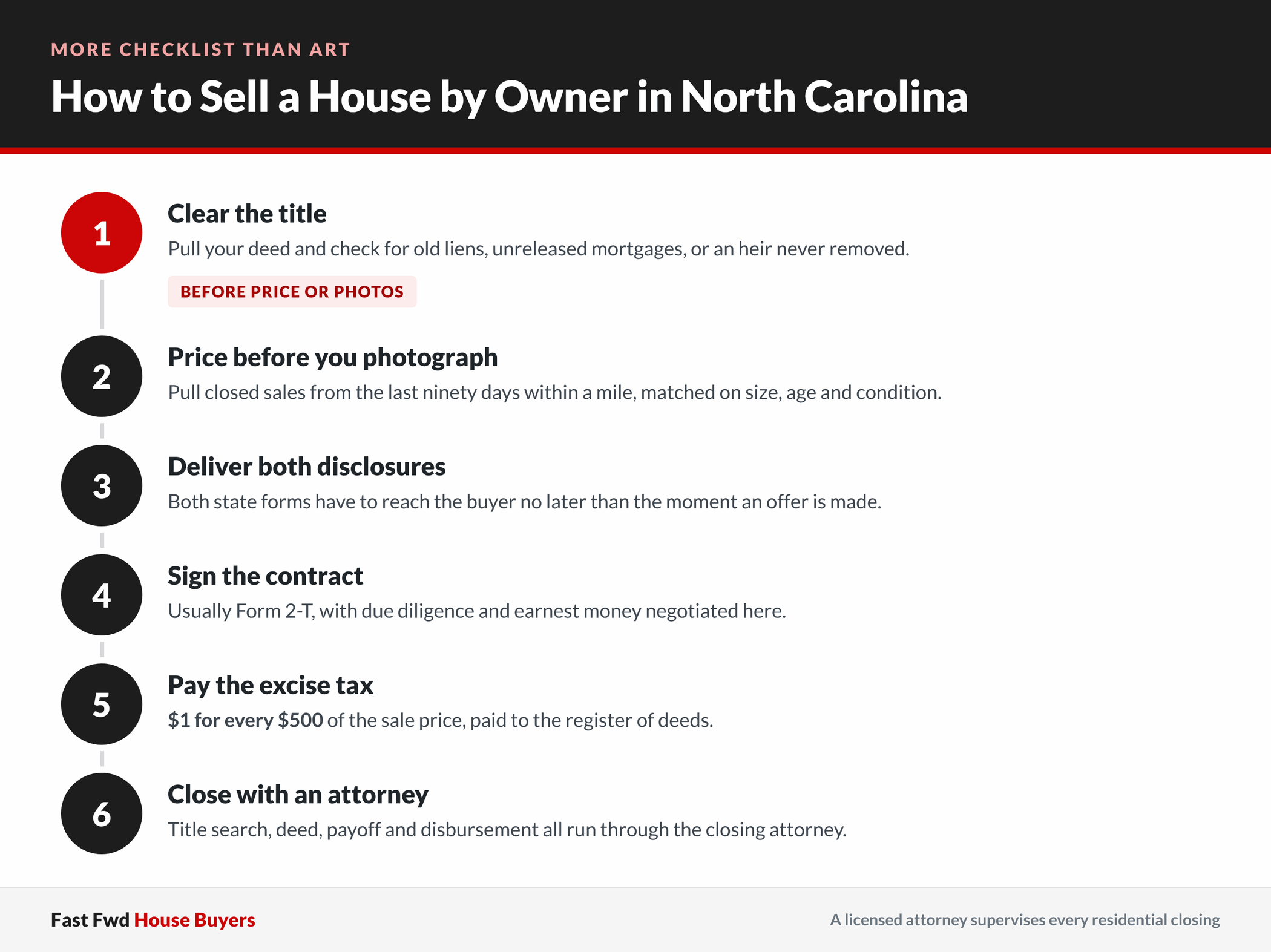
“I’m not a real estate professional, I’ll miss something that costs me the sale.” Fair concern, and the honest answer is that the process is more checklist than art.
Pull your deed, confirm legal ownership is clean, and check for old liens, unreleased mortgages, or a sibling who was never removed after an estate settled. Title surprises kill more closings than inspections do.
Get title squared away first, before price or photos.
Price the property before you photograph it, because the price determines how much staging and repair work is worth doing. Then handle the disclosures covered below, because the buyer has to have them at a specific point in the transaction.
Once a buyer makes an offer, you’ll move to a written contract, typically the NC REALTORS Offer to Purchase and Contract form, Form 2-T. Due diligence and earnest money deposits get negotiated here. North Carolina also uses a due diligence period, during which the buyer can walk away for any reason. The due diligence fee they pay is generally non-refundable.
Sellers here owe a state excise tax on the deed, set at one dollar for every $500 of the sale price or fraction of it, under G.S. 105-228.30. The statute puts that obligation on the transferor, payable to the county register of deeds before the deed can be recorded. Seven counties in the state add a local land transfer tax on top of the state rate. Your register of deeds can confirm whether yours is one of them.
How Do You Price a House by Owner Without a Real Estate Agent?
Zillow’s Zestimate is a starting point and nothing more, and pricing it off that number alone is the single most expensive mistake in this whole process.
Real comparable sales are what set the price. Pull closed sales from the last ninety days within a mile of your property, matched on square footage, bedroom count, age, and condition.
The state’s deeds are public record, and the excise tax stamps recorded on each one reveal the actual sale price to anyone who looks. Your county register of deeds office gives you that data free.
Pay attention to what the market is doing underneath your price. Statewide, the median asking price slipped to $399,900 in October 2026 from $409,220 in August, per FRED’s listing price series. A softening market punishes aggressive pricing harder than a rising one does.
For unusual properties, a pre-listing appraisal is worth paying for. It runs a few hundred dollars and gives you a defensible number for a historic Asheville bungalow or a 40-acre parcel in Chatham County where comps are thin.
Set a price-drop date before you list, and write it down. Without that trigger, you’ll rationalize staying put for another three weeks, then another, and the listing goes stale.
Overpricing costs you more than time. Buyers watch days on market, and a listing that’s sat for sixty days invites lowball offers from people who assume you’re desperate. Price it correctly from day one and you’ll negotiate from strength.
How Do You Market a House by Owner to Reach More Buyers?
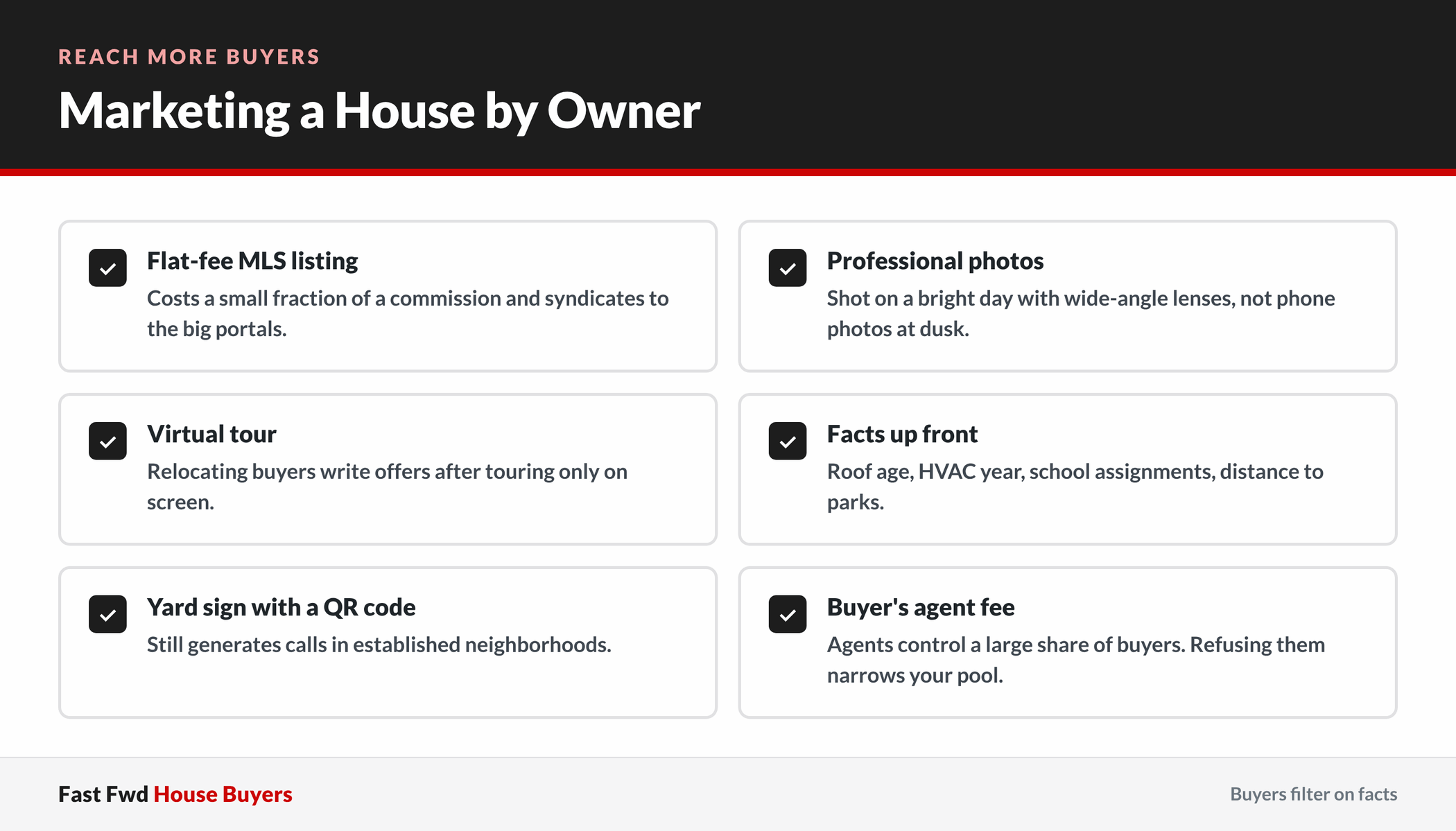
Putting the house on the MLS through a flat-fee listing costs a small fraction of a commission. It’s the best money an unrepresented seller spends. Your listing syndicates to Zillow, Realtor.com, Redfin, and Homes.com from there.
Photos deserve a hired professional. Shot on a bright day with wide-angle lenses, professional images stop a thumb mid-scroll, and phone photos taken at dusk do the opposite.
Virtual tours earn their keep with out-of-state buyers, and North Carolina gets a lot of those. Relocating buyers regularly write offers on Charlotte and Raleigh homes after touring only on screen.
Lead your description with roof age, HVAC install year, school assignments, and distance to the Blue Ridge Parkway or a local greenway. Buyers filter on facts.
A yard sign still generates calls, especially in established neighborhoods where people drive through looking. Add a rider with your phone number and a QR code linking to your listing.
Open houses produce neighbors and tire-kickers more often than buyers, though a Sunday afternoon open house in a high-traffic area like Oakwood or Dilworth can be worth the effort.
What about offering a buyer’s agent commission? Offer it. Agents control a large share of North Carolina buyers, so refusing to pay them narrows your pool at the exact moment you need it widest. Offering a competitive buyer’s agent fee keeps your listing in the running, and you still save the listing side.
When marketing stalls out after a month of effort, that’s useful information rather than a verdict on you. A direct offer from Fast Fwd House Buyers gives you a baseline number so you can measure the open market against it.
What Paperwork Do You Need to Sell a House by Owner in North Carolina?
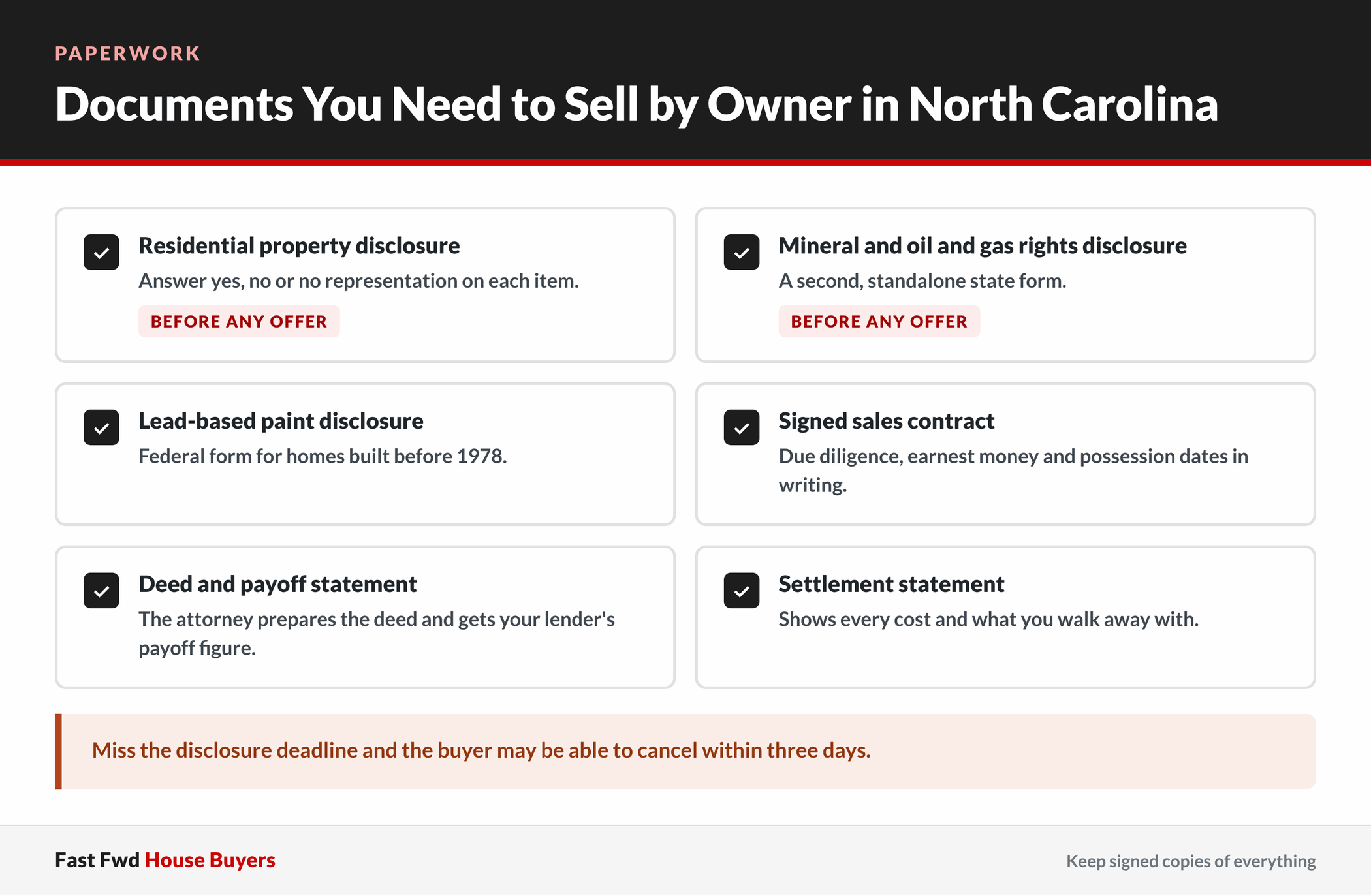
Two separate disclosure forms are mandatory here, not one, and the second one trips up plenty of unrepresented sellers. Sellers must deliver the Residential Property and Owners’ Association Disclosure Statement. Next comes a standalone Mineral and Oil and Gas Rights Disclosure Statement. Both apply to homes of one to four dwelling units, as the North Carolina Real Estate Commission explains.
You don’t have much room to work with on timing. Under G.S. 47E-5, you must deliver the disclosure no later than the moment the buyer makes an offer, per Nolo’s summary of North Carolina disclosure law. Miss that window and the buyer gains a right to rescind the contract. The Real Estate Commission describes this as within three days of contract formation or three days from receiving the statement, whichever comes first.
Answering “no” when you knew otherwise is where fraud exposure lives, so “no representation” is the safer answer on anything you genuinely can’t speak to.
Homes built before 1978 trigger the federal lead-based paint disclosure, which covers a lot of housing stock in older North Carolina neighborhoods.
Beyond disclosures you’ll have a signed sales contract, the deed itself, a payoff statement from your lender, and the settlement statement.
Sellers are also wise to keep signed copies of everything. Paperwork disputes surface months after closing, and your file is your defense.
Should You Hire a Real Estate Attorney to Sell a House by Owner in North Carolina?
You don’t get to choose on this one, and that’s a good thing for you.
North Carolina follows an attorney-closing model. The State Bar’s Authorized Practice Advisory Opinion 2002-1 concludes that a non-lawyer handling a residential real estate closing engages in the unauthorized practice of law, and G.S. 10B-134.25 preserves that requirement in statute. A title company alone can’t close your sale in this state.
What you do get to choose is how much lawyer you want.
A closing attorney runs the title search, resolves defects, prepares the deed, handles the excise tax payment, and disburses funds. That’s the baseline every transaction gets. What an unrepresented seller should consider adding is contract review before signing, which usually runs a modest flat fee, because it catches terms that cost thousands later.
Have the attorney check due diligence length, repair negotiation language, possession dates, and anything the buyer’s agent wrote in by hand.
Bring the attorney in early, not the week before closing. Title problems take time to clear. An unreleased deed of trust from a refinance in 2008 can hold up a closing for weeks while someone chases a bank that no longer exists.
A couple in Hickory listed with two different agents over fourteen months and watched both listings expire without a single written offer. Their house had a converted carport and a long gravel drive that financed buyers kept balking at. When they finally decided to sell the house by owner, their attorney spotted a boundary issue in the title work that neither agent had ever surfaced. I’ve seen that exact kind of miss sink closings before. Clearing it was what made the eventual sale possible.
Budget for the attorney as a cost of doing business when you sell a house by owner in North Carolina. It’s the least negotiable expense in the sale and the one that protects you most.
Frequently Asked Questions About Selling a House by Owner in North Carolina
Is It Legal to Sell a House by Owner in North Carolina Without a Real Estate Agent?
Yes. No law in North Carolina requires you to hire a listing broker, and unrepresented sellers close transactions here every week. You still have to meet the same disclosure obligations as any other seller, and a licensed attorney still has to supervise the closing itself.
How Much Can I Save Selling by Owner in North Carolina?
Your savings come from the listing side of the commission, since most sellers still offer compensation to the buyer’s agent to keep the home competitive. Against that savings, subtract your flat-fee MLS listing, professional photography, attorney fees, and the state excise tax on the deed, which you’d owe either way. Many sellers net somewhere in the low single digits as a percentage of the sale price.
Do I Have to Give Buyers a Disclosure Form If I Sell a House by Owner?
You do. The disclosure requirement applies whether or not a broker is involved. Both required state forms have to reach the buyer before or at the moment an offer is made. Missing that deadline hands the buyer a cancellation right you’d rather not give away.
What Happens If My House by Owner Listing Doesn’t Sell?
You’ve got three options: reduce the price, improve the presentation, or change your approach entirely. Plenty of sellers try the for sale by owner route for a month or two and learn what the market is telling them. Then they either list with a broker or take a direct cash offer. None of those outcomes is a failure, since you gathered real information about what buyers will pay.
Can I Sell a House by Owner in North Carolina If I Still Owe on My Mortgage?
Absolutely, and plenty of sellers do. Your closing attorney requests a payoff statement from your lender and pays the loan balance out of the sale proceeds at closing. You receive whatever’s left after the excise tax, prorated property taxes, and other closing costs come out. If you owe more than the home is worth, talk to your lender about a short sale before you list.
How Long Does a for Sale by Owner Closing Take in North Carolina?
Once you’re under contract, expect roughly 30 to 45 days for a financed buyer, driven mostly by the lender’s underwriting and appraisal timeline. A cash buyer can close in two to three weeks, limited mainly by how fast the title search comes back. The due diligence period you negotiate sits inside that window.
Selling by Owner in the Charlotte Area
Charlotte is our home market, and sellers here weigh the same tradeoffs. Canopy MLS counted 4,304 homes sold across the 16-county Charlotte region in June 2026, with the median sales price rising to nearly $417,000, WFAE reported.
If you’d like a direct number to hold up against your own listing, we buy houses as-is in places like Concord and across the rest of the state too.
Want a Number to Compare Against?
If you’re weighing whether to sell a house by owner in North Carolina or take a different route, I’m happy to talk it through. That holds even if a direct sale isn’t the right answer for you. Sometimes the most useful thing is just getting a real number to compare against. Reach out whenever you’re ready. No pressure, no obligation. When you’re ready, contact Fast Fwd House Buyers or fill out the short form below.